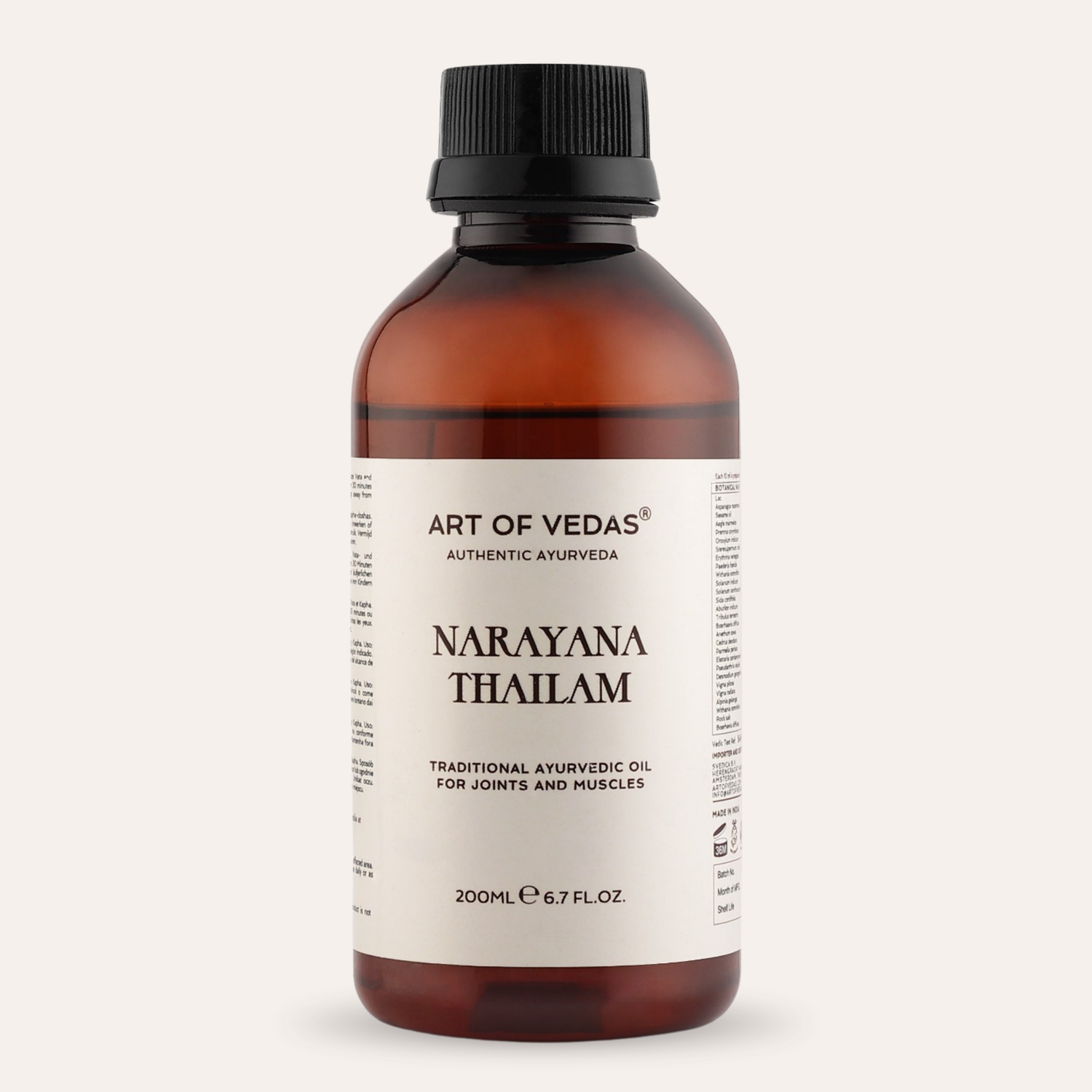





Narayana Thailam

(1)

Classical Ayurvedic Oil for Neuromuscular Strength & Joint Comfort

153,00 kr

Narayana Thailam ist eine klassische ayurvedische Formulierung, die in der Bhaishajya Ratnavali für die Unterstützung von Neuromuskulatur und Gelenken erwähnt wird. Dieses kraftvolle Öl kombiniert das vollständige Dashamoola (zehn Wurzeln), doppelt starke Ashwagandha und Punarnava sowie traditionelle nervenstärkende Kräuter wie Bala und Shatavari in einer nährenden Sesamölbasis.

Benannt nach Lord Narayana (Vishnu), wird dieses Öl seit Jahrhunderten traditionell verwendet, um die Muskelkraft, den Gelenkkomfort und das Gleichgewicht des Nervensystems zu unterstützen. Die wärmende, tief eindringende Formel ist ideal für Abhyanga-Massagen und wird in der Ayurveda besonders geschätzt, um Menschen mit Schwäche, Steifheit oder allgemeinem Vata-Ungleichgewicht zu helfen.
Nettogehalt

ZUTATEN

Lacca, Asparagus racemosus Pulver, Sesamum indicum öl Abutilon Indicum Extract, Tribulus Terrestris Extract, Boerhaavia Diffusa Extract, Anethum Sowa Powder, Cedrus Deodara Powder, Parmelia Perlata Powder, Elettaria Cardamomum Powder, Pseudarthria Viscida Powder, Desmodium Gangeticum Powder, Vigna Pilosa Powder, Vigna Radiata Powder, Alpinia Galanga Powder, Withania Somnifera Pulver, Natriumchlorid, Boerhaavia -Diffusa -Pulver.

Narayana Thailam

153,00 kr

153,00 kr

Narayana Thailam - Art of Vedas

Warum Narayana Thailam verwenden?

Narayana Thailam stands as one of the foundational therapeutic oils in classical Ayurveda, predating even the more elaborate Mahanarayana formulation. Referenced in the Bhaishajya Ratnavali under Vatavyadhi Chikitsa (treatment of Vata disorders), this oil represents centuries of traditional knowledge for supporting the musculoskeletal and nervous systems.

What sets Narayana Thailam apart is its comprehensive yet balanced approach. With 27 Ayurvedic herbs including the complete Dashamoola, this formulation addresses Vata imbalance at multiple levels, from the surface muscles to the deeper nervous tissue.

The Complete Dashamoola: Ten Roots Working Together

At the heart of Narayana Thailam lies Dashamoola, the famous Ayurvedic combination of ten roots that has been revered for millennia. This formula contains both the Brihat Panchamoola (five larger tree roots) and Laghu Panchamoola (five smaller plant roots), providing comprehensive Vata-pacifying action.

The Brihat Panchamoola includes Bilva (Aegle marmelos), Agnimantha (Premna corymbosa), Shyonaka (Oroxylum indicum), Patala (Stereospermum colais) and Paribhadra (Erythrina variegata). These larger roots are traditionally associated with deeper, more substantial action on the body's framework.

The Laghu Panchamoola comprises Brihati (Solanum indicum), Kantakari (Solanum xanthocarpum), Gokshura (Tribulus terrestris), Shalaparni (Desmodium gangeticum) and Prishnaparni (Pseudarthria viscida). These lighter roots complement the formula with their own unique properties.

Together, the complete Dashamoola is traditionally understood to pacify Vata dosha, support comfortable movement and promote overall structural wellbeing.

Traditional Uses

Narayana Thailam has been traditionally used in Ayurveda for:

  • Supporting comfortable movement in joints and muscles
  • Promoting muscle strength and tone
  • Supporting the nervous system
  • Full-body Abhyanga massage for Vata balance
  • Local application to areas of discomfort
  • Panchakarma therapies including Basti and Nasya (under practitioner guidance)

Who Benefits Most

Narayana Thailam may be particularly suitable for:

  • Those experiencing muscle weakness or fatigue
  • Individuals seeking support for joint comfort and mobility
  • Those with predominantly Vata constitution or Vata imbalance
  • People recovering from physical exertion
  • Anyone seeking a traditional strengthening oil for regular Abhyanga
  • Those looking for neuromuscular support as part of their wellness routine

Wie man Narayana Thailam verwendet

Wärmen Sie das Öl vorsichtig und tragen Sie es über den Körper oder auf betroffene Bereiche wie den Rücken, die Schultern, die Beine oder die Gelenke auf. Massieren Sie mit festen, kreisförmigen Strichen bis absorbiert. Lassen Sie das Öl vor dem Baden 20 bis 30 Minuten auf dem Körper bleiben. Verwenden Sie täglich oder wie von Ihrem ayurvedischen Praktiker.

Klassische Ayurveda-Referenz

Narayana Thailam is documented in the Bhaishajya Ratnavali, a comprehensive 18th-century Ayurvedic text compiled by Kaviraj Govinda Das Sen. The formulation appears in the Vatavyadhi Chikitsa chapter, which addresses disorders arising from Vata dosha imbalance.

The oil is also referenced in Sahasrayogam, a classical Kerala text containing thousands of Ayurvedic formulations, and is included in the Ayurvedic Formulary of India (AFI), the official government compendium of standardized Ayurvedic preparations.

Notably, Narayana Thailam is considered the parent formulation from which the more elaborate Mahanarayana Thailam later evolved through the addition of more herbs.

Sanskrit Name and Etymology

Sanskrit: नारायण तैलम् (Nārāyaṇa Tailam)

The name combines:

  • Nārāyaṇa: A name of Lord Vishnu, the preserver deity in Hindu tradition, signifying the oil's preserving and protective qualities
  • Taila/Thailam: Medicated oil

The divine name reflects the high regard in which this formulation has been held, suggesting therapeutic power of the highest order.

Classical Indications

In classical Ayurvedic texts, Narayana Thailam is indicated for:

  • Pakshaghata - Hemiplegia, paralysis affecting one side of the body
  • Ardita - Facial paralysis, Bell's palsy type conditions
  • Gridhrasi - Sciatica and radiating leg discomfort
  • Sandhigata Vata - Joint disorders, degenerative conditions
  • Manyastambha - Neck stiffness and cervical conditions
  • Katishoola - Lower back discomfort
  • Vatavyadhi - General Vata disorders affecting movement and sensation

Classification

Narayana Thailam is classified as:

  • Vatahara Thailam - Vata-pacifying oil
  • Balya - Strength-promoting
  • Brimhana - Nourishing, building
  • Bahya Prayoga - External application
  • Abhyantara Prayoga - Internal use (under practitioner guidance only)

Ayurvedic Pharmacology (Dravyaguna)

Rasa (Taste): Predominantly Tikta (bitter), Kashaya (astringent), Madhura (sweet)

Guna (Qualities): Snigdha (unctuous), Guru (heavy), Ushna (warming)

Virya (Potency): Ushna (warm), balanced by cooling herbs like Shatavari and Shaileyaka

Vipaka (Post-digestive effect): Madhura (sweet)

Dosha Action:

  • Vata Shamaka (strongly pacifies Vata) - Primary action
  • Kapha Shamaka (mildly pacifies Kapha) - Secondary action
  • Generally neutral to mildly aggravating for Pitta when used externally in moderation

Karma (Actions)

  • Vatahara - Pacifies Vata dosha
  • Vedanasthapana - Promotes comfort and ease
  • Shothahara - Supports normal inflammatory response
  • Balya - Promotes strength
  • Brimhana - Nourishes and builds tissues
  • Srotoshodhana - Supports channel clarity

Dhatu (Tissue) Affinity

Narayana Thailam has particular affinity for:

  • Mamsa Dhatu - Muscle tissue
  • Asthi Dhatu - Bone tissue
  • Majja Dhatu - Nerve tissue and marrow

Panchakarma Applications

In traditional Ayurvedic Panchakarma therapy, Narayana Thailam is used for:

  • Abhyanga - Therapeutic oil massage
  • Matra Vasti - Oil enema therapy (50ml daily, 7-14 days)
  • Nasya - Nasal administration (8 drops per nostril)
  • Shirovasti - Head oil retention therapy
  • Shirodhara - Continuous oil stream on forehead
  • Kati Vasti - Lower back oil pool therapy

Note: These Panchakarma applications should only be performed by or under the supervision of qualified Ayurvedic practitioners.